Walking Gait Analysis Canberra
How You Move Tells the Whole Story
Walking Gait Analysis Basic
Ever notice how some people glide effortlessly while others stomp around like a one-man marching band? That, my friend, is gait — your personal walking signature. At The Body Lab in Canberra, we decode that signature through detailed gait analysis to reveal exactly how your body moves, compensates, and occasionally throws a tantrum.
Because every step tells a story — and we’re here to translate it.
What Is Gait Analysis, Really?
Gait analysis is the study of how you walk — how each joint and muscle contributes to the smooth symphony of movement that keeps you upright and moving forward (most days).
We break it down into something called a gait cycle, which is just one full step — from the moment one foot hits the ground to when that same foot hits again. Simple enough. Within that single stride lies a mountain of information about posture, joint health, and efficiency.
At The Body Lab, we measure that full cycle using video, pressure plate data, and good old-fashioned eyes trained to spot movement like hawks — biomechanical hawks.
The Two Main Acts of Walking
Every step is made up of two big moments — think of them as the yin and yang of movement:
Stance Phase (≈60%) – when your foot’s on the ground, dealing with gravity, balance, and momentum.
Swing Phase (≈40%) – when your foot’s in the air, making its grand comeback for the next contact.
While one foot’s on duty stabilising the body, the other is flying forward, setting up the next act. Each leg takes turns being the dependable best friend while the other shows off.

Breaking Down the Gait Cycle
We follow the gold standard set by Perry & Burnfield (2010) in Gait Analysis: Normal and Pathological Function — a beautiful piece of bedtime reading if you’re into joint angles and force vectors. Here’s how it goes:
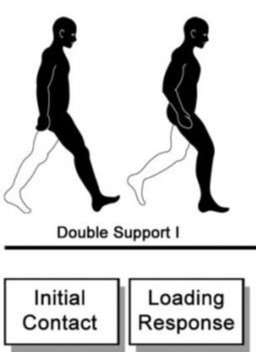
1. Weight Acceptance (0–12%)
The show starts when your heel hits the ground. The body’s centre of mass shifts from the trailing foot to the front foot, and your muscles spring into action to absorb shock and stabilise.
Initial Contact (0–3%)
The heel (usually the outer edge) strikes first — the official “hello” between your foot and the floor.
Loading Response (3–12%)
The body’s weight rolls forward; the knee flexes slightly to cushion the impact; the foot lengthens and flattens to spread the load. Think shock absorption meets smooth transition.
2. Single limb support (12-50%):
Single limb support involves momentum of the body over the front foot and weight-bearing stability of the mass over its base of support. The entire body rest over one foot and returns to brief moment of neutrality of the entire skeleton. This phase can be broken down further into midstance and terminal stance.
Now you’re balancing your entire body over one leg. This is where stability and control matter most. The skeleton briefly passes through a neutral position before preparing to move again.
Midstance (12–31%)
The shin straightens, weight transfers smoothly over the foot, and everything aligns momentarily — your biomechanical “zen” moment.
Terminal Stance (31–50%)
The heel lifts, your body’s momentum shifts forward, and the ball of the foot becomes the new boss. Balance, propulsion, and elegance — all in one split second.

:3. Swing Phase (50–100%)
Your foot leaves the ground, but the work doesn’t stop. The leg must flex, clear the floor, swing forward, and land in perfect position for the next strike.The swing phase can be broken down into 4 sub-phases.
Pre-Swing (50–62%)
The foot pushes off, the weight shifts to the other leg, and your toes wave goodbye to the ground.
Initial Swing (62–75%)
The hip, knee, and ankle flex to lift the foot — clearance is key here.
Mid-Swing (75–87%)
The leg swings forward, thigh peaks in flexion, and the lower limb lines up for re-entry.
Terminal Swing (87–100%)
Final adjustments: the knee extends, the ankle preps, and the foot gets ready for its next grand landing. Curtain up. Repeat.

Video Gait Analysis: See What Your Body’s Been Up To
If your body could talk, your gait video would be its tell-all interview.
A video gait analysis lets us slow things down — frame by frame — to spot why you’re getting pain, stiffness, or feeling “off” in your movement. It’s not about chasing symptoms; it’s about finding the real reason your body keeps sending you SOS signals.
Because when you can see the problem, you can actually fix it.
What Is a Video Gait Analysis?
Every time you take a step, your bones, joints, and muscles perform a coordinated dance routine — thousands of moving parts working in perfect harmony (or close enough). That’s your gait.
A video gait analysis captures this dance in slow motion. We record you walking (or running) on a treadmill in your natural rhythm, then dissect what’s happening at every phase — from heel strike to toe-off.
It’s part science, part detective work, and a little bit of biomechanics art.
What Does a Video Gait Analysis Show?
This is where things get juicy. Using high-definition video and gait software, we analyse your movement frame by frame — zooming in on joint angles, timing, and compensations you’d never notice with the naked eye.
Then we show you exactly what we’re seeing, in plain English (no biomechanics bingo). You’ll finally understand whythat ache, pull, or fatigue keeps returning.
Here are a few examples of what we might uncover:
The Early Heel Lift
A tight Achilles tendon can cause one heel to lift too early, forcing extra pressure onto your forefoot. Over time, that twist at the big toe joint can contribute to bunions or joint pain.
The Over-Pronator’s Tale
If your arch collapses too long or too hard, your plantar fascia is constantly under tension — a fast track to heel pain and plantar fasciitis.
The Supination Spiral
Rolling excessively onto the outside of your foot (supination) leaves your ankle unstable and prone to repeated sprains.
The Hip Hitch
Lifting your leg from your hip instead of bending the knee properly can set off one-sided hip or low-back tension.
The Lazy Powerhouse
Sometimes your big stabilising muscles have clocked off, leaving the smaller ones to overwork and burn out — leading to fatigue, tension, or “mystery pain.”
In short: we find the why behind the ouch.
Who Benefits from a Gait Analysis?
Most of our clients come in because something hurts — feet, knees, hips, or back. By analysing your gait, we can identify the exact mechanical pattern driving that pain.
For others (especially runners and athletes), video gait analysis is about optimising performance. We can find subtle inefficiencies in your stride, improve joint sequencing, and make movement more effortless and powerful.
Either way, you’ll move better and understand your body on a level most people never get to see.
Health from the Feet Up
At The Body Lab, we believe your feet are the foundation of your entire body. If something’s off down there, it echoes upward — ankles, knees, hips, spine, even your shoulders.
Our gait analysis isn’t just about your feet. It’s about whole-body balance, alignment, and motion. We use the insights from your video to guide treatment, improve mobility, and reduce recurring pain. Think of it as a root-cause roadmap for better movement.
Video Gait Analysis FAQs
How does a video gait analysis work?
First, we get you comfortable walking barefoot — either here in the clinic or via video you record from your own space. You’ll walk for about a minute while we capture your natural stride. Then we slow everything down, frame by frame, and review the footage together. You’ll see exactly what we see — no jargon, no guesswork, just clear insights into how your body moves.
Do I need one?
If you’ve got persistent foot, leg, hip, or back pain that hasn’t budged with standard treatment — absolutely. Gait analysis often uncovers the real cause behind recurring problems that other approaches miss.
Shoes or barefoot?
We record barefoot only. Barefoot walking reveals your true movement mechanics — no cushioning, no correction, just raw, honest motion. We can still review your footwear separately if needed to see how it’s influencing your movement.
How long does it take?
Our advanced comprehensive gait analysis session runs for about 1 hour and 45 minutes. That includes your full movement assessment, slow-motion video review, detailed explanation, and a tailored treatment plan to start improving your mechanics right away.
When do I get results?
Instantly. You’ll see your movement breakdown in real time, and you’ll leave with a written follow-up summary outlining the key findings and your next steps — so you can start changing the way you move from day one.
How do I book?
Easy — just head to our Bookings Page or call The Body Lab Canberra. We’ll set up your session and get you walking (and feeling) better in no time. Your future self — and your feet — will thank you.
Why It Matters
Every single one of these phases is beautifully coordinated — until it isn’t.
Maybe your heel doesn’t lift properly. Maybe your knee rotates too early. Maybe your foot flattens like a pancake instead of springing like a trampoline.
When one link in the chain loses rhythm, the rest of the body improvises — hips twist, spines arch, and muscles overwork. That’s when pain, stiffness, or fatigue start crashing your movement party.
That’s where The Body Lab’s Gait Analysis steps in (pun intended). We pinpoint where your movement deviates, explain why it matters, and give you a clear roadmap to better balance, posture, and efficiency — from the ground up.
What You’ll Get at The Body Lab
✔️ Full video gait assessment
✔️ Pressure plate scan (static + dynamic)
✔️ Postural and movement analysis
✔️ Joint motion assessment (foot, ankle, knee, hip, pelvis)
✔️ Practical treatment and exercises to restore natural motion
✔️ Detailed report + long-term plan sent straight to your inbox
You’ll see how your body moves in real time — and more importantly, how to move it better.
Ready to Walk Smarter, Not Harder?
Book your Walking Gait Analysis in Canberra today.
Because understanding your gait isn’t just for athletes — it’s for anyone who wants to move efficiently, stay pain-free, and keep walking tall (and straight).