The Hidden Connection Between Your Jaw, Breathing, Posture and Pain
What If Your Jaw Isn’t The Problem?
Most people think jaw pain starts in the jaw.
Just like most people think foot pain starts in the foot.
Or back pain starts in the back.
The body rarely works that way.
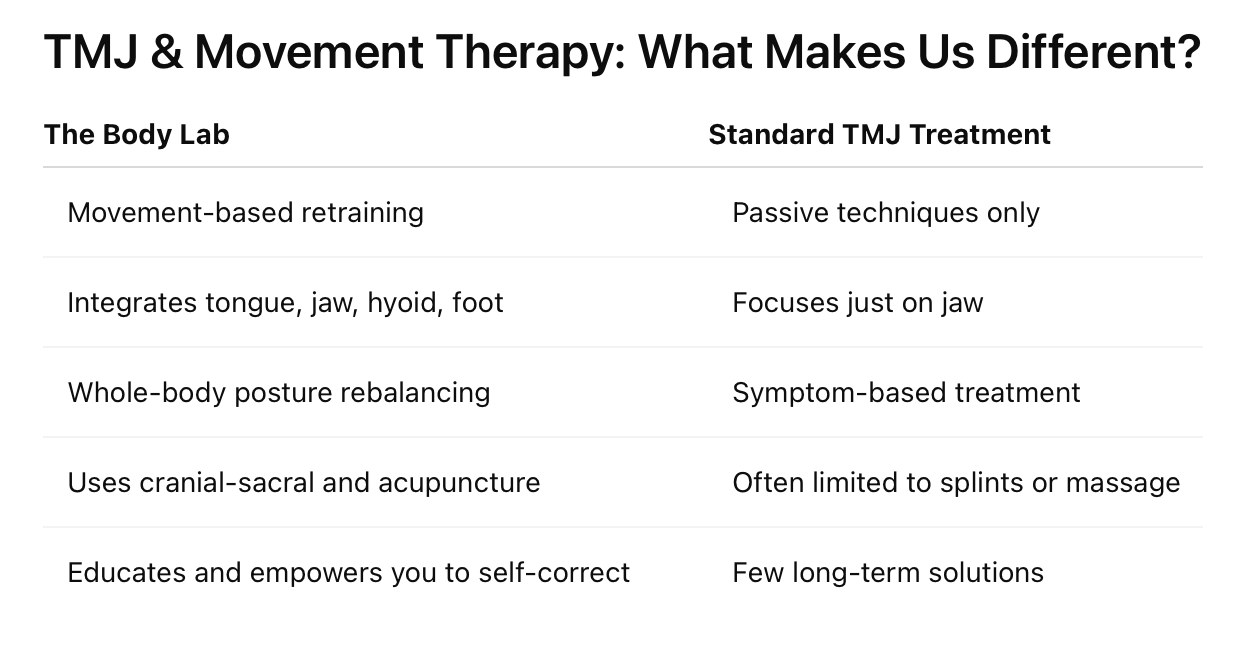
At The Body Lab, we view the jaw as part of a much larger system involving breathing, posture, balance, movement, the nervous system, and even the way you walk.
Because your jaw doesn’t work alone.
It lives inside a complex network that connects your tongue, airway, neck, skull, ribcage, spine, pelvis and feet.
When one part of that system changes, the rest of the body adapts.
Sometimes those adaptations become symptoms.
Sometimes they become headaches.
Sometimes they become neck pain.
Sometimes they become poor sleep, jaw clicking, facial tension, dizziness, or chronic tightness that never seems to fully resolve.
The question isn’t:
“What’s wrong with my jaw?”
The question is:
“Why is my jaw working so hard in the first place?”
Your Jaw Is Part Of Your Airway System
Every second of every day your body has one primary job.
Stay alive.
And to do that, it needs oxygen.
When breathing becomes inefficient, the body begins creating compensations.
The head may move forward.
The neck muscles may become overactive.
The tongue may sit lower in the mouth.
The jaw may begin clenching to create stability.
The shoulders may elevate.
The nervous system may remain in a constant state of low-grade tension.
Over time these patterns become normal.
Until they don’t.
Common Signs Your Jaw May Be Part Of The Bigger Picture
Many people who come to The Body Lab aren’t actually seeking jaw treatment.
They arrive because of:
Headaches and migraines
Neck tension
Shoulder tightness
Facial pain
Jaw clicking or locking
Teeth grinding
Poor sleep
Snoring
Sinus congestion
Ear pressure or ringing
Difficulty concentrating
Persistent postural tension
Feeling exhausted despite sleeping
The jaw often turns out to be one piece of a much larger puzzle.
The Better Airway System
At The Body Lab, jaw assessment sits within our Better Airway System.
Rather than looking at the jaw in isolation, we investigate how the entire breathing and postural system is functioning.
This may include:
Jaw motion assessment
Tongue posture assessment
Hyoid bone positioning
Airway function screening
Cranial mobility assessment
Upper cervical spine assessment
Breathing pattern analysis
Ribcage movement assessment
Walking and posture assessment
Because breathing, posture and movement are inseparable.
Why We Sometimes Look At Your Feet When Assessing Your Jaw
This usually surprises people.
You arrive because your jaw hurts.
Then I ask you to walk.
There is a reason.
Walking is one of the most repetitive movements your body performs.
Every step transfers force through the feet, legs, pelvis, spine, ribcage, neck and head.
If force is not moving efficiently through the body, the jaw often becomes part of the compensation strategy.
Sometimes improving foot loading reduces jaw tension.
Sometimes improving breathing changes head position.
Sometimes restoring spinal motion improves TMJ symptoms.
The body doesn’t care which professional “owns” a body part.
It simply creates solutions wherever it can.
The Tongue: The Muscle Nobody Thinks About
If the jaw is underrated, the tongue is practically invisible.
Yet tongue position influences:
Airway size
Swallowing
Jaw position
Cervical spine stability
Breathing mechanics
Facial muscle tension
Sleep quality
A poorly positioned tongue can contribute to:
Mouth breathing
Snoring
Forward head posture
Jaw tension
Reduced airway efficiency
Which is why tongue posture forms an important part of many assessments.
What Happens During An Assessment?
Every person is different.
The goal is not simply to identify where symptoms are occurring.
The goal is to understand why your body created them.
Your assessment may include:
Breathing Assessment
How efficiently are you breathing?
Are you using your diaphragm effectively?
How is your ribcage moving?
Jaw & Airway Assessment
How does the jaw open and close?
How does the tongue function?
How is the airway positioned?
Postural Assessment
How is your head positioned over your spine?
How is your ribcage interacting with your pelvis?
Movement Assessment
How does your body transfer force while standing and walking?
Where are compensations occurring?
Our Approach To Care
Depending on what we find, treatment may involve a combination of:
Cranial Therapy
Gentle techniques aimed at improving mobility through the skull, jaw, upper neck and nervous system.
Acupuncture
Used to help regulate the nervous system, reduce muscle tension and support recovery.
Movement Therapy
Specific exercises designed to restore efficient movement patterns and improve body awareness.
Breathing Retraining
Helping reconnect the airway, ribcage, diaphragm and posture.
Jaw & Tongue Retraining
Simple exercises to improve coordination, function and long-term stability.
Conditions We Commonly See
Many clients seek help for:
TMJ Dysfunction
Jaw clicking and locking
Teeth grinding and clenching
Headaches and migraines
Chronic neck tension
Forward head posture
Breathing dysfunction
Sleep-related breathing concerns
Sinus congestion
Post-concussion symptoms
Vestibular and balance issues
More Than Symptom Relief
Our goal isn’t simply to reduce jaw pain.
Our goal is to help your body become more efficient.
When breathing improves, posture often improves.
When posture improves, movement often improves.
When movement improves, tension often decreases.
The jaw simply becomes one part of a healthier system.
Is The Better Airway System Right For You?
If you’ve been chasing symptoms from practitioner to practitioner and still feel like something is missing, it may be time to look at the bigger picture.
Because headaches aren’t always a head problem.
Jaw pain isn’t always a jaw problem.
And sometimes the solution starts by understanding how your entire body works together.
Book Your Initial Assessment
The Body Lab Canberra
21 Chisholm Street, Ainslie ACT
Initial Assessment: 60 minutes
Follow-Up Sessions: 45 minutes
Begin your journey towards better breathing, better posture, better movement and a body that works the way it was designed to.
Research-Backed, Clinically Proven
We draw on the latest studies in biomechanics, neurology, dentistry, and cranial research:
Cuccia A, Caradonna C. The relationship between the stomatognathic system and body posture. Cranio. 2009.
Gangloff P et al. Effects of jaw clenching on postural stability. Neurosci Lett. 2000.
Berni KC et al. Relationship between dental occlusion and posture in children. J Appl Oral Sci. 2011.
Huang Y et al. The role of tongue posture in craniofacial development. Orthod Craniofac Res. 2016.
Guimaraes KC et al. Effects of oropharyngeal exercises on sleep apnea. Am J Respir Crit Care Med. 2009.
Mayuga et al. The hyoid bone's role in cervical spine and airway mechanics. Clin Anat. 2014.
Okeson JP. Management of Temporomandibular Disorders and Occlusion. 7th ed.
Ready to Fix Your Jaw?
Book your session today and take the first step toward a better jaw, spine, breath, and life.
Location: 21 Chisholm Street, Ainslie ACT (Home Clinic)
Session Duration: 60 mins initial, 45 mins follow-ups
Let’s unlock your TMJ and get the rest of your body back online.
more information can be found here