Podiatrist vs The Body Lab Canberra — Which One Fits Your Feet?
Written by Riccardo Galeotti, The Body Lab Canberra
If You Have Foot Pain, You Have Options — But Not All Are the Same
If you’re struggling with heel pain, plantar fasciitis, bunions, or stiff, sore arches, you’re probably deciding whether to see a podiatrist or someone like Riccardo Galeotti at The Body Lab Canberra.
Both help with foot pain — but they approach it from very different angles.
A podiatrist focuses on the foot as a structure.
Riccardo focuses on the foot as part of a living, moving system.
When to Choose a Podiatrist
Podiatrists are university-trained allied health professionals and AHPRA-registered. They diagnose and treat medical and mechanical problems of the foot, ankle, and lower leg.
✅ Best if you have:
Sudden or acute injuries (sprains, fractures, ingrown toenails)
Skin or nail issues (fungal infections, corns, calluses, warts)
Diabetic or arthritic foot complications requiring medical monitoring
Structural deformities (bunions, flat feet, claw toes) that may need orthotics
Footwear prescription or custom orthotics for load correction
Podiatrists work within a medical framework, often using orthotics, footwear modification, or localised rehab to treat the affected area.
Example local clinics: CBR Podiatry and My Podiatrist Canberra offer diagnostic imaging, orthotic therapy, and acute injury management.
When to Choose Riccardo Galeotti at The Body Lab Canberra
Riccardo is an AHPRA-registered Chinese Medicine Practitioner and Certified Strength & Conditioning Coach with over 18 years of clinical experience.
But unlike most practitioners, he doesn’t start with your pain — he starts with how you move.
Why Riccardo’s Approach Is Different
While podiatrists often work “top-down” through medical correction, Riccardo works “ground-up” through biomechanics — understanding how your foot, ankle, knee, hip, and spine interact as one system.
Foot pain rarely exists in isolation. A stiff ankle, rotated tibia, or tilted pelvis can all distort how your foot loads the ground — eventually leading to pain in the heel, arch, or big toe.
Rather than just treating symptoms, Riccardo’s mission is to restore efficient movement across the whole body, so the foot can do what it’s designed to: absorb force, adapt, and propel you forward.
Why Biomechanics First — Not Needles
Many people expect acupuncture to be Riccardo’s main tool. While he is deeply trained in Classical Chinese Acupuncture, he often chooses movement and biomechanics over needles — and here’s why:
Movement reveals the cause.
Pain is the body’s way of telling you something isn’t moving right. Correcting the pattern that created the problem is often more effective than treating the pain itself.
Your body needs to relearn movement, not just relax.
Acupuncture can reduce inflammation and calm nerves, but if the underlying movement pattern stays the same, the pain usually returns.
Biomechanics changes how you load and use your body — permanently.
Restoring joint motion, weight distribution, and sequencing creates long-term change that needles alone can’t achieve.
Needles still have their place.
Acupuncture can complement movement therapy for pain modulation, tendon repair, or neurological reset — but it’s rarely the first step. The focus is on active, measurable change, not passive relief.
“If your foot keeps hurting, it’s not because you need more needles — it’s because your body hasn’t relearned how to move differently.”
Riccardo’s Foot Pain Method — Step by Step
Each appointment at The Body Lab is tailored, but a typical assessment includes:
3D Gait and Pressure-Plate Analysis
Measures how your feet load through each phase of walking — identifying hidden asymmetries.
Functional Biomechanics Testing
Assesses joint motion through the foot, ankle, knee, and hip in all three planes of motion (sagittal, frontal, transverse).
Manual Therapy & Nerve Releases
Restores glide and tension balance through the lower limb and foot arches.
Movement Retraining (Anatomy in Motion – AiM)
Teaches your body to move more efficiently — re-establishing the foot’s tripod, arches, and propulsive mechanics.
Strength & Integration
Builds resilience through intrinsic foot drills, balance training, and functional movement patterns.
Optional Acupuncture & Cranial Work
Used selectively for chronic pain or when the nervous system needs recalibration.
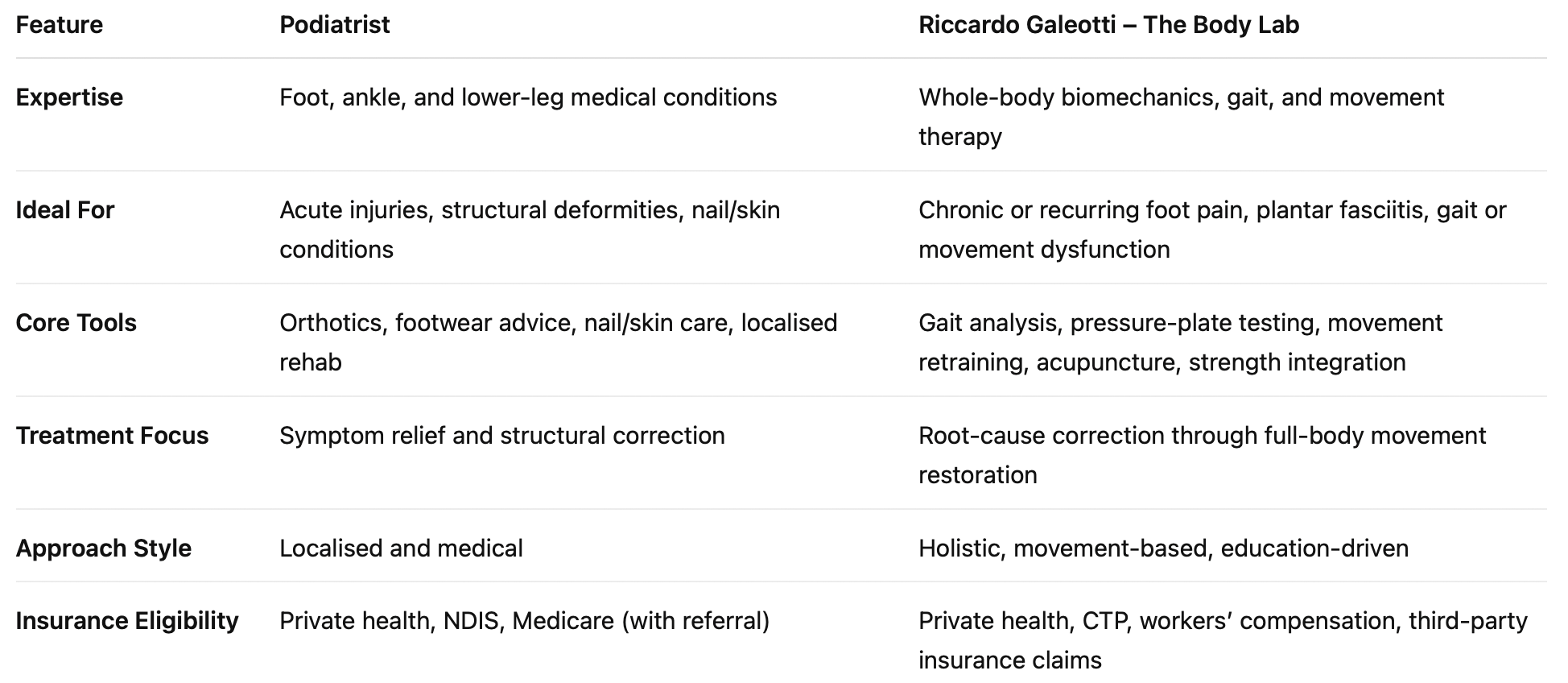
Side-by-Side Comparison
In Summary
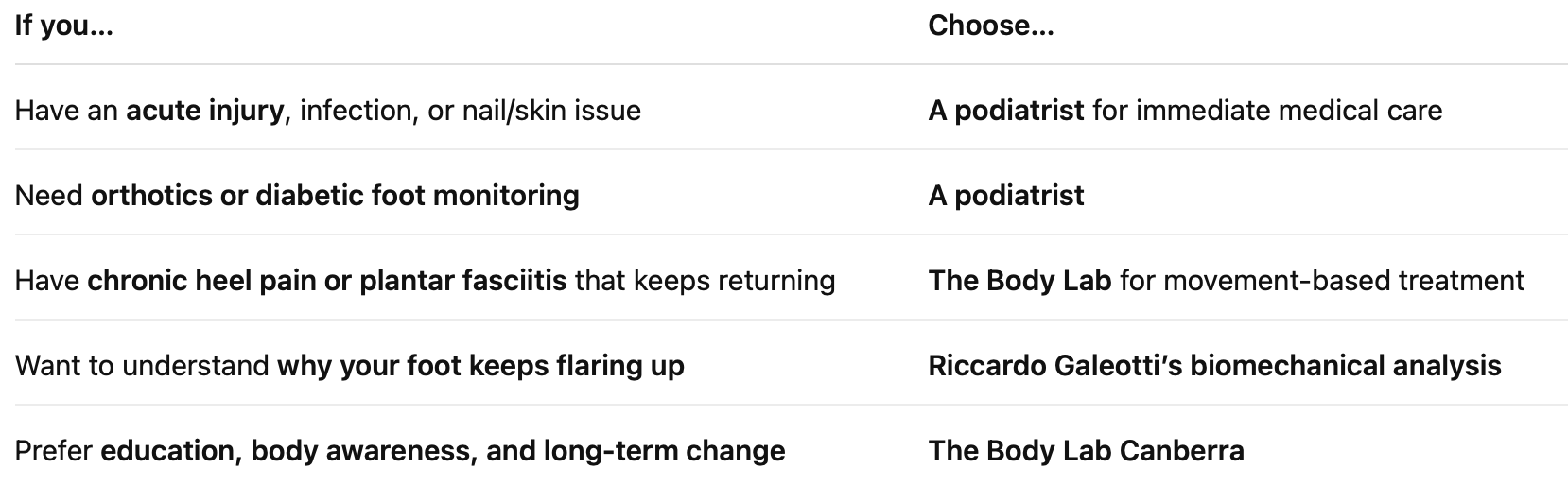
If you’re dealing with a specific, acute, or medical foot problem, a podiatrist is the best first call.
But if you’ve been through orthotics, stretches, and still have pain, it’s time for a different perspective — one that looks at how your entire body moves from the ground up.
Riccardo’s biomechanics-first approach identifies the root cause of pain, retrains movement patterns, and restores natural function — often helping clients who’ve “tried everything” finally move pain-free.
Next Step
Book a Foot & Movement Assessment
📞 Call 0432 785 135 or visit www.thebodylab.au
Located in Ainslie – servicing Canberra and surrounding regions.
Disclaimer
This article is for general informational purposes only. For a diagnosis or medical advice, please consult a qualified healthcare professional.