How We Actually See Your Feet Working (And Why a Pressure Plate Changes Everything)
The Truth About “Looking at Your Feet”
Most assessments go something like this:
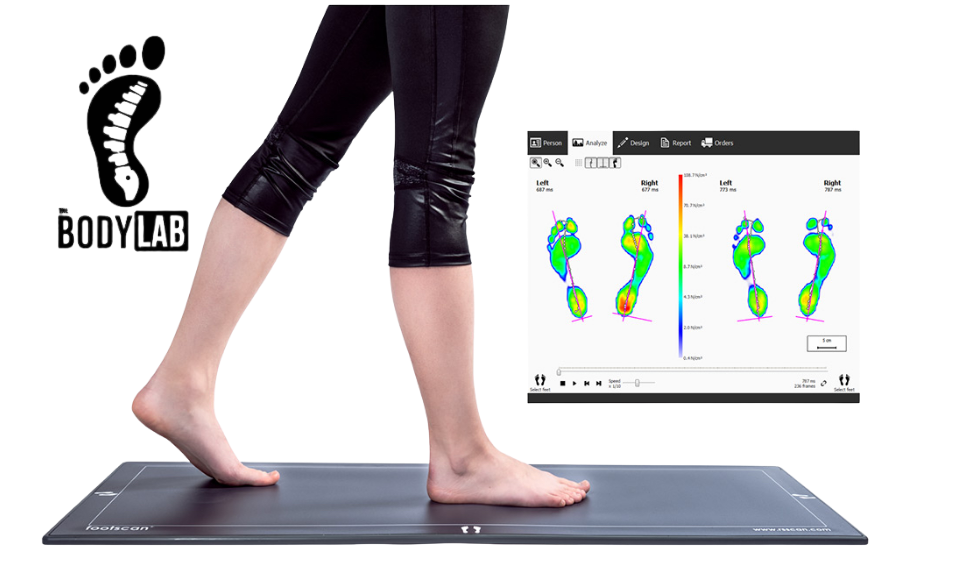
Plantar Pressure Plate Technology - The Body Lab
“Walk over there… okay cool… looks good.”
Which is a bit like diagnosing a car engine by listening to it with the radio on.
You might catch the obvious stuff…
But you miss the real story.
That’s where a pressure plate comes in.
What Is a Foot Pressure Plate?
A foot pressure plate is essentially a high-resolution sensor that maps how your foot interacts with the ground.
Not just where your foot is…
But how it loads, shifts, rotates, and pushes.
It gives us:
Pressure distribution (where you load)
Timing (when you load)
Movement pathways (how you move across the foot)
Force patterns (how efficiently you push off)
Think of it as turning your foot into a live data stream instead of a guessing game.
Why This Matters
Here’s the kicker:
Pain is rarely about the spot that hurts.
Your plantar fascia isn’t just randomly angry.
Your knee isn’t being dramatic for fun.
Your back isn’t “tight” because it woke up grumpy.
It’s usually a loading problem.
And loading = how your foot interacts with the ground.
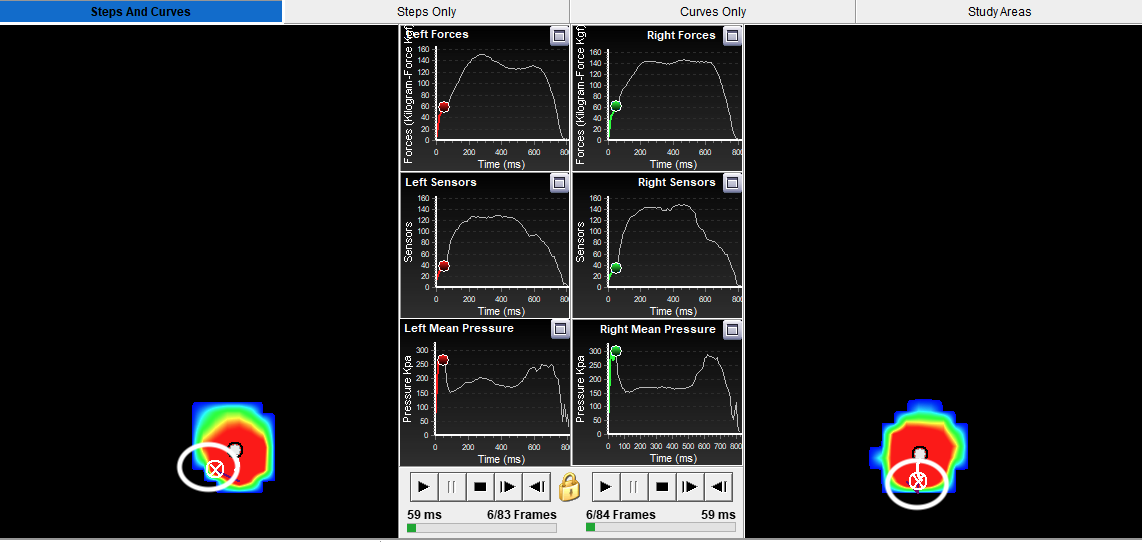
Heel Strike Dynamic Analysis
What We’re Actually Looking For
1. Where Does Your Weight Go First?
Does your heel take load properly?
Or does your body skip that phase like it’s trying to avoid a bill?
If the heel doesn’t load well →
Everything above it compensates.
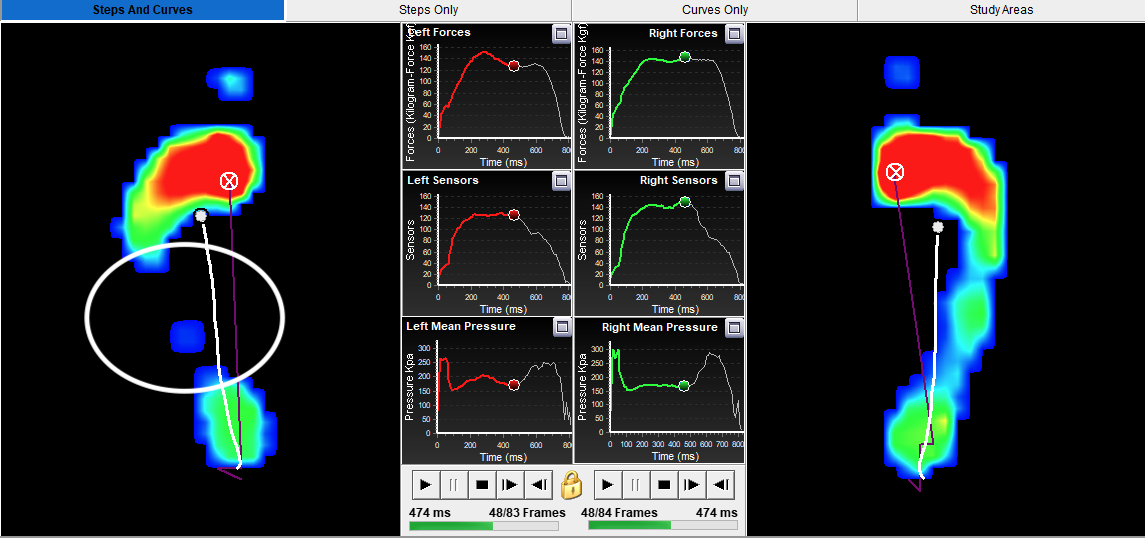
Dynamic Plantar Pressure Plate Analysis Mid-Stance
2. Can Your Foot Absorb Load (Pronation)?
Pronation gets a bad rap.
But without it, you’ve basically turned your foot into a brick.
We’re looking at:
Does the arch adapt?
Does pressure spread across the foot?
Or does it dump into one area like a bad investment?
3. Can You Recoil and Push Off?
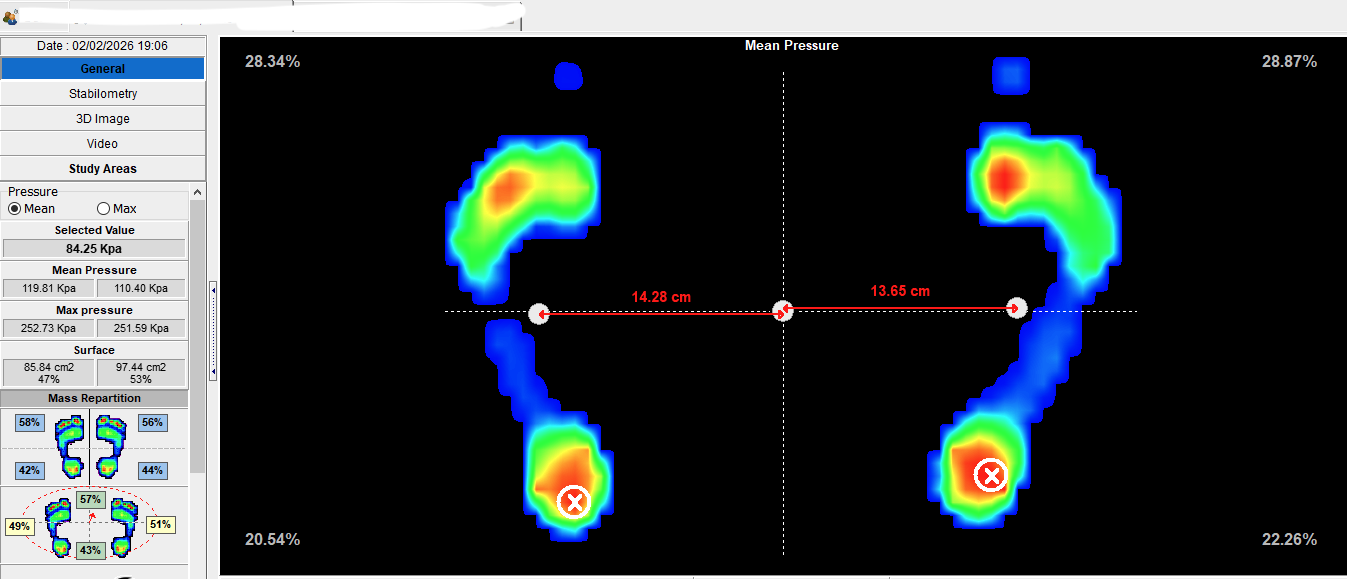
Static Plantar Pressure Analysis Canberra - The Body Lab
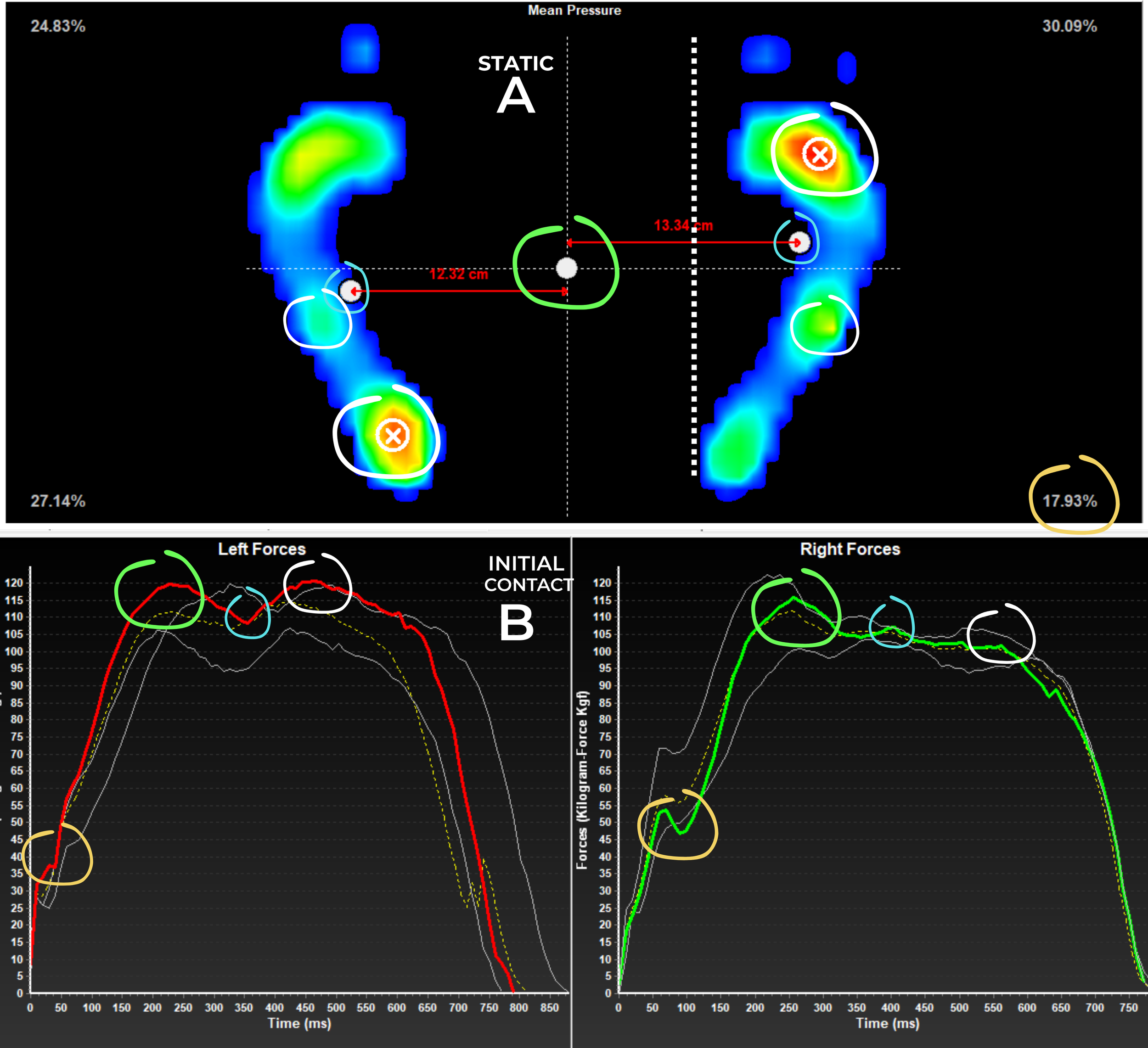
Force and Pressure Readings - The Body Lab Plantar pressure Plate
Static vs Dynamic (AKA Standing Still vs Real Life)
Most clinics assess you standing.
Cool… but when was the last time your pain happened while standing perfectly still like a mannequin?
The pressure plate lets us compare:
Static posture (how you hold yourself)
Dynamic movement (how you actually use your body)
Those two are often completely different.
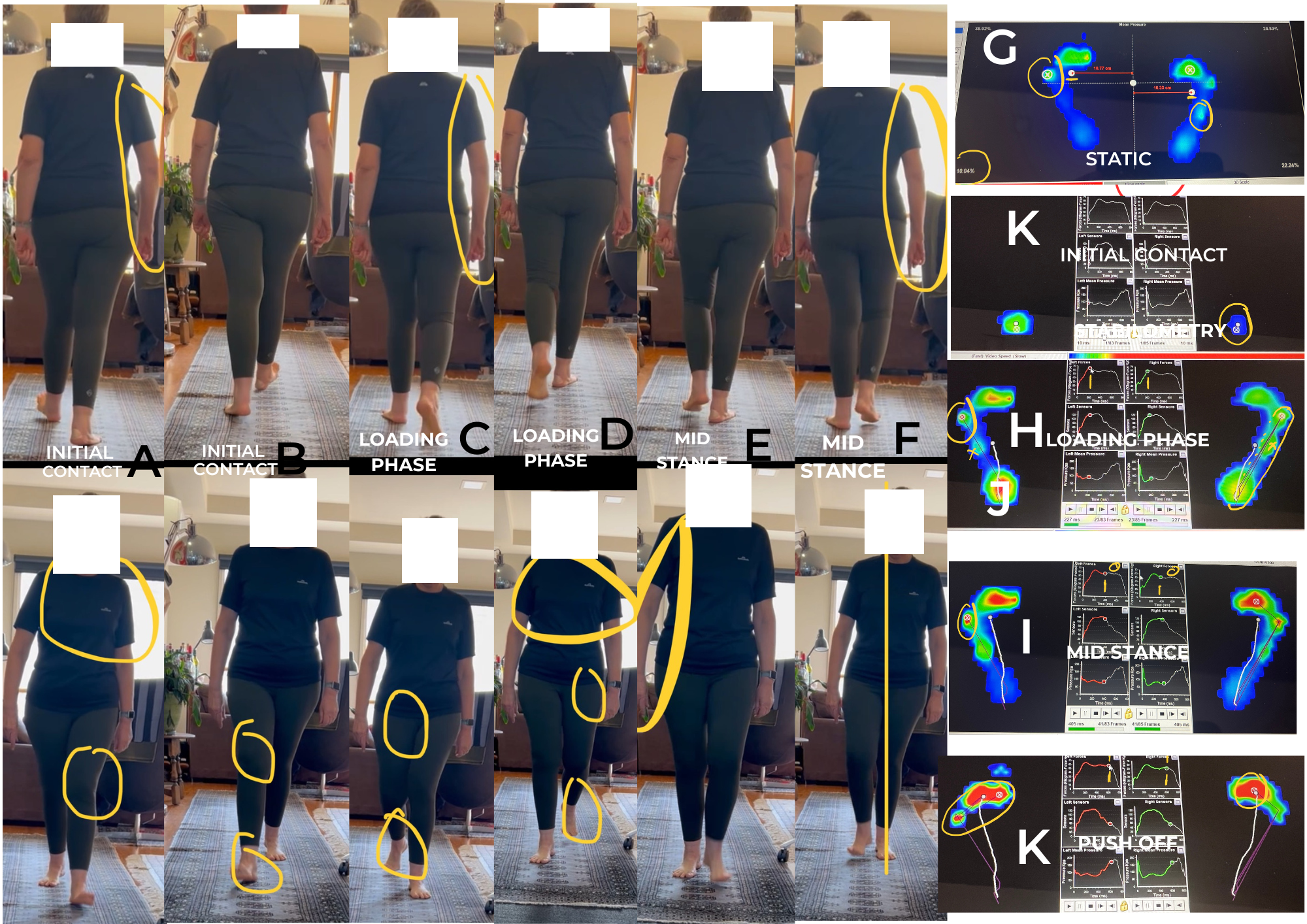
Gait analysis and Plantar pressure plate mapping
The Big Advantage: No Guesswork
Instead of saying:
“I think your arch is collapsing”
“Maybe you’re not using your big toe”
We can say:
“You’re not loading your heel properly”
“Your midfoot isn’t accepting load”
“You’re bypassing your big toe during push-off”
And more importantly…
We can show you.
Where This Fits in Your Treatment
At The Body Lab, the pressure plate isn’t the treatment.
It’s the truth-teller.
We combine it with:
Gait analysis (how you walk)
Movement assessment (how joints actually move)
Hands-on work (yes, we still use our hands)
Targeted exercises (that actually match your pattern)
So instead of random exercises…
You get a plan that matches your movement system.
What Clients Usually Say
“That explains why my calf is always tight…”
“I didn’t realise I wasn’t using my big toe at all”
“I can actually feel the difference when I walk now”
That’s the goal.
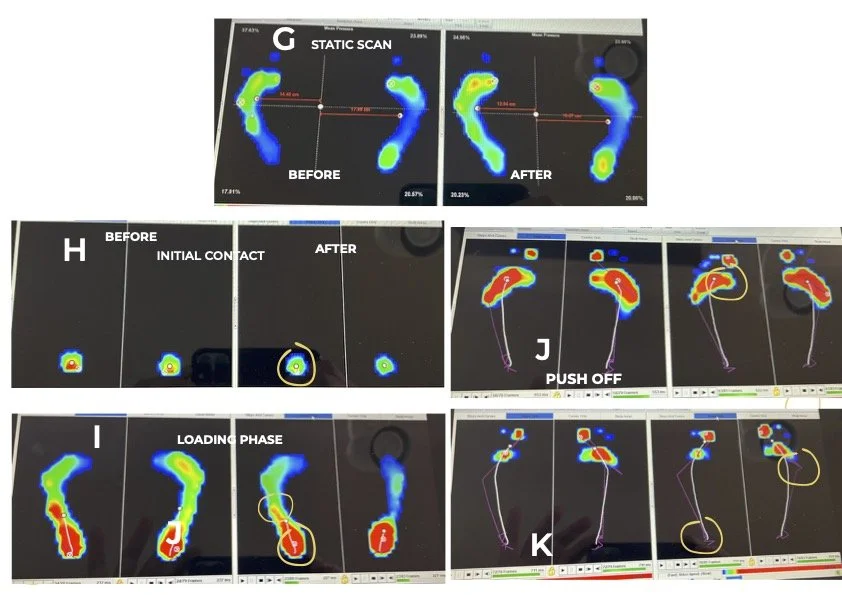
Dynamic Plantar Pressure Plate Analysis
Not just understanding…
But changing how you move.
If you don’t understand how your foot loads the ground,
you’re guessing your way through treatment.
And guessing works…
Right up until it doesn’t.
Want to See What Your Feet Are Actually Doing?
If you’re dealing with:
It might not be a strength problem.
It might be a loading problem
.👉 Book your Foot Pressure & Gait Assessment in Canberra
and let’s actually see what’s going on.
References
Cavanagh, P.R. & Lafortune, M.A. (1980). Ground reaction forces in distance running. Journal of Biomechanics.
Orlin, M.N. & McPoil, T.G. (2000). Plantar pressure assessment. Physical Therapy.
Rosenbaum, D. & Becker, H.P. (1997). Plantar pressure distribution measurements. Clinical Biomechanics.
Hughes, J. et al. (1993). The importance of the toes in walking. Journal of Bone and Joint Surgery.
Nigg, B.M. (1999). Biomechanics of the Musculo-skeletal System.