
The Foot Reset Program
Fix Your Feet in 5 Steps
[Start Your Foot Reset]
A simple, step-by-step online program.
Learn how your foot is actually supposed to move when you walk — and fix what’s missing.
Not random exercises.
Not guesswork.
Movement, timing, and sequence.
Why I created this
Over the past 10+ years, I’ve worked with people dealing with foot pain, stiffness, bunions, and movement problems that don’t seem to resolve.
And I kept seeing the same thing.
People were doing exercises…
…but nobody was showing them:
how their foot should actually move when they walk
At the same time, I’ve been teaching therapists how to assess and restore foot function — focusing on the simplest and most effective ways to improve movement.
This program brings that together.
A clear way to:
understand what your foot should do
see what’s missing
and fix it properly
What actually is The Foot Reset Program
How this works
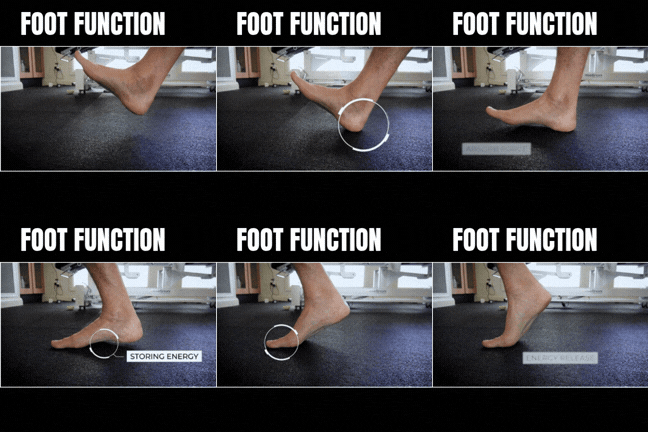
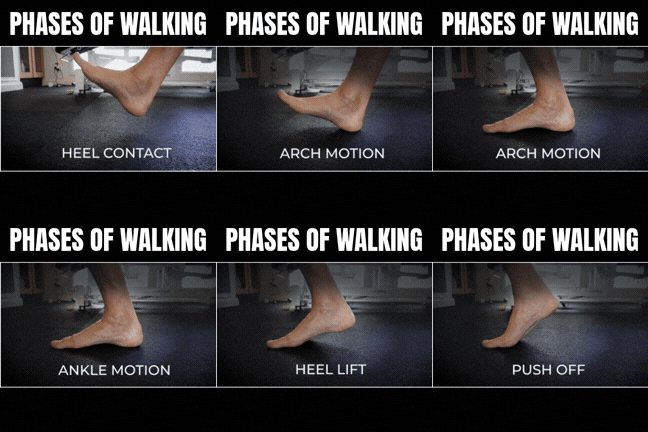
This program is built around the phases of walking — not random exercises.
You’ll learn how your foot should move through each step:
how your heel lands and absorbs load
how your arch responds and distributes pressure
how your ankle rotates so your body can move over the foot
how your big toe prepares the foot for push-off
how your foot becomes a spring to move you forward
Then you’ll:
identify what’s missing
restore those movements
and apply it to real walking
When the timing changes…
you feel the difference almost immediately
This program is for you if…
your feet feel stiff or tired
your arches don’t feel like they’re doing much
your heel hurts when you walk
your big toe doesn’t move well
your calves are always tight
you feel unstable on one leg
you’ve tried things… and still feel like something is missing
What happens next
When your foot moves at the right time:
walking feels easier
your balance improves
your body stops overworking
tension reduces through your calves, knees, hips, and back
Because your body finally has a base that works.
This isn’t about quick fixes.
It’s about restoring movement so it sticks.
What makes this different?
This isn’t another strengthening program.
(There are already enough random foot exercises online to keep your toes busy for life.)
This program focuses on something most people — and most treatments — completely miss:
how your foot moves during each phase of a step
Every step you take follows a sequence.
If that sequence is off:
your timing is off
your load shifts
your body compensates
Instead of giving you random exercises…
This program shows you:
what your foot should do
when it should do it
what’s missing
and how to fix it
And when the timing changes…
you feel the difference almost immediately
What you’ll learn inside
Module 1 — Welcome
Understand how the program works, what to expect, and how to approach it without overthinking. This sets the foundation so you know exactly what to focus on from the start.
Module 2 — Self-Assessment
Learn how to assess your own foot movement and identify what’s working and what’s missing. This gives you a clear starting point instead of guessing.
Module 3 — Heel Motion
Restore how your heel contacts the ground and begins the walking cycle. This is where proper load absorption starts, and most people get it wrong.
Module 4 — Arch Mobility
Teach your arch to soften, respond to load, and distribute pressure effectively. A mobile arch reduces stress on the rest of the foot and lower limb.
Module 5 — Ankle Rotation
Unlock the rotational movement through the ankle that allows smooth transition over the foot. This is a commonly missing piece that affects the entire chain.
Module 6 — Toe Lift & Windlass
Reconnect your big toe with the arch so the foot can stabilise properly during movement. This helps restore the natural windlass mechanism needed for efficient walking.
Module 7 — Push-Off
Improve how your foot becomes a lever to move you forward. This phase builds efficiency, reduces effort, and completes the movement cycle.
Module 8 — Daily Reset Routine
Bring all the movements together into a simple, repeatable sequence you can use daily. This helps reinforce changes and build consistency over time.
Module 9 — Walking Integration
Apply everything you’ve learned into real walking so it becomes natural and automatic. This is where the work translates into how you actually move day to day.
Bonus — Wedge Integration
Learn how to use wedges to change timing, awareness, and load through the foot. This adds another layer to help you feel and improve movement more effectively.
-
It can absolutely help if you’re in pain — especially when poor foot movement is part of the problem. But this program isn’t about chasing symptoms. It’s about restoring how your foot moves so the stress doesn’t keep landing in the same place.
-
No. It’s just as useful if you have:
stiff ankles
poor balance
tight calves
bunions
or movement issues further up the chain
Think of it as a movement reset, not just a pain program.
-
Yes — you’ll use The Body Lab Wedges (Foot Reset Tools).
They help you feel and change movement more clearly by adjusting timing and load through the foot. You can also use simple things like towels for small variations — and we show you exactly how.
-
There’s no fixed finish line.
This is a self-paced program designed for ongoing change.
As your foot starts to move differently, things shift — and when one joint changes, the whole foot adapts.
That’s why you’ll revisit sections and notice what improves (and what still needs work).
That’s not a flaw. That’s the process.
-
Yes. You don’t need to be flexible, fit, or know anything about biomechanics.
This is built for real people — not just practitioners or those who already live in activewear.
-
Most people feel something change quite quickly — especially when timing and movement start to improve.But lasting change comes from repeating the right movements consistently.
Quick shifts in feeling.
Long-term changes in function.
-
That’s usually why people end up here.
Most approaches focus on:
stretching
strengthening
or supporting the foot
But they don’t address how the foot moves during walking.
This does.