
Muscle Builds Fast. Tendons Don’t Care About Your Two-Week Protein Challenge.
There’s a strange little fantasy floating around the health world that goes something like this:
“If I just smash enough protein shakes, my body will rebuild itself like Wolverine after a CrossFit class.”
Muscle? Sure, it’s relatively quick to adapt.
Tendons, cartilage, ligaments, and bone?
Different story entirely.
Those tissues operate more like government infrastructure projects. Slow approvals. Long timelines. Occasional complaints from the knee department.
And a new 2026 study published in the American Journal of Clinical Nutrition has thrown a fairly large kettlebell through the idea that short-term whey supplementation somehow fast-tracks connective tissue repair.
The Study That Measured Tissue Rebuild Rates in Living Humans
Researchers led by Houtvast used a heavy-water tracer technique to measure how quickly different knee tissues rebuild themselves in older adults undergoing knee replacement surgery. Yes. Actual human tissue turnover rates.
Not cell culture. Not mice. Not “promising preliminary data” involving a rat doing Pilates.
Real human tissue.
Half the participants kept eating normally.
The other half added 40 grams of whey protein daily for two weeks.
At the end?
No measurable increase in rebuild rates across any tissue.
Not muscle.
Not tendon.
Not cartilage.
Not bone.
Which is clinically fascinating… because the rebuild timelines between tissues were wildly different.
Your Body Is Running Multiple Biological Clocks
The results looked something like this:
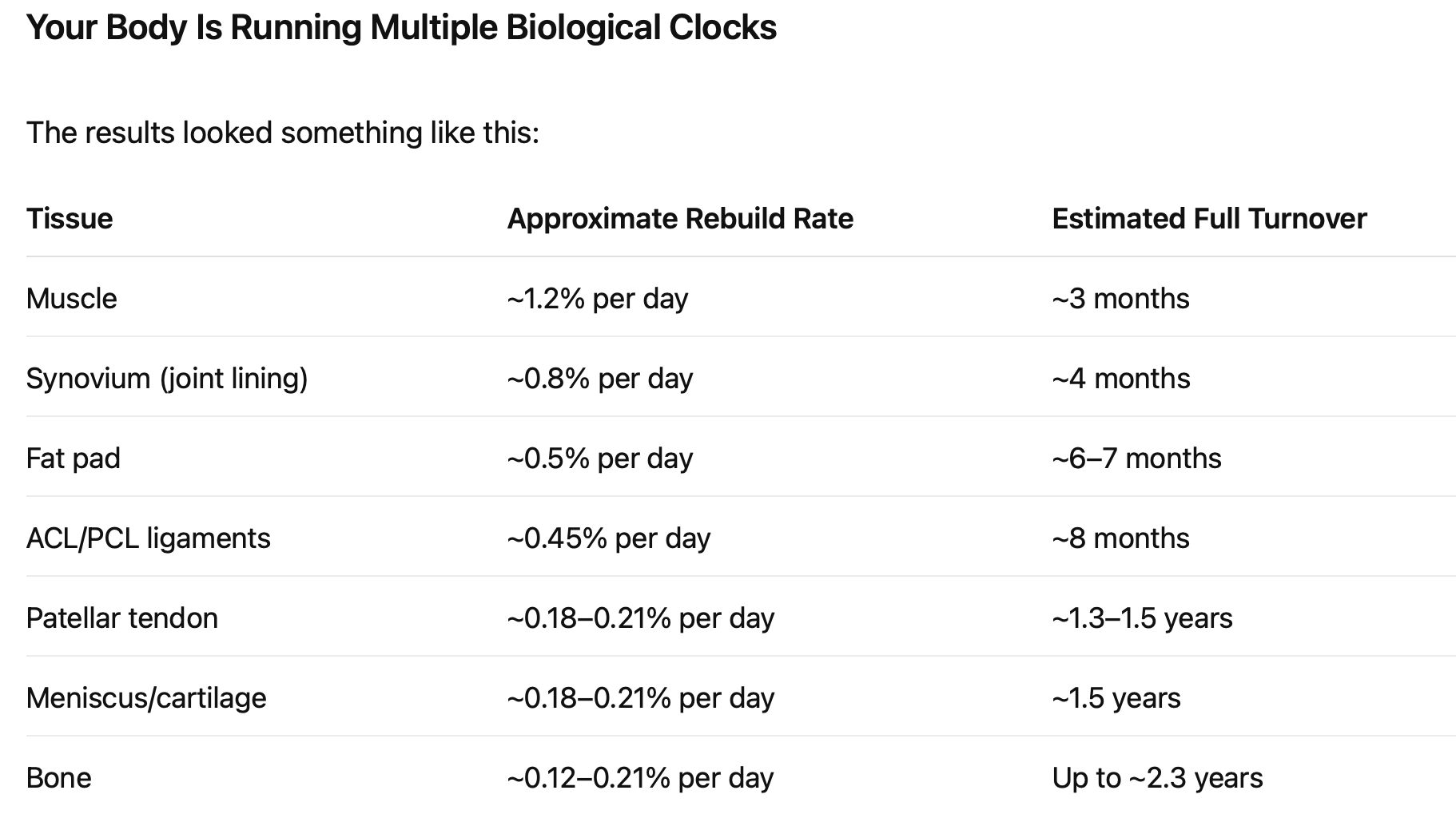
Read that again slowly.
Your quadriceps can theoretically rebuild themselves in a few months. Your cartilage is basically using dial-up internet.
And bone? Bone is renovating a heritage-listed building with one tradie and a clipboard.
Why This Actually Matters Clinically
This is where people confuse substrate availability with biological speed limits. Protein absolutely matters. Every tissue in your body depends on amino acids. Without adequate protein intake, tissue repair suffers.
But this study suggests something important: Adding extra whey for two weeks does not suddenly override the natural rebuild timeline of connective tissue. And honestly… this matches what clinicians see every day.
Tendons Heal Slowly
A 55-year-old Achilles tendon doesn’t care that you discovered vanilla whey isolate on Instagram. It remodels at the speed tendons remodel.
Which is painfully slow. Cartilage Is Even Slower, Cartilage has limited blood supply and low metabolic turnover.
That’s one reason osteoarthritis rehabilitation often requires months — sometimes years — of progressive loading and movement adaptation.
Bone Runs on Mechanical Signals
Bone density changes respond primarily to loading:
• resistance training
• impact
• strain
• force transmission
• hormonal environment
Not simply “more protein.” Protein helps support the process. It doesn’t magically accelerate the biological clock.
Muscle Is the Fast-Responding Tissue
This is the key distinction.
Muscle protein synthesis is highly responsive to:
• resistance training
• amino acid intake
• sleep
• recovery
• hormonal signalling
Which is why protein timing research matters more for muscle than for connective tissue. Research by Moore and colleagues showed older adults benefit from higher per-meal protein dosing to overcome “anabolic resistance” — essentially age-related reduced sensitivity to amino acids.
Current evidence still supports roughly:
• ~1.6 g/kg/day total protein
• spread across 3–4 meals
• with each meal reaching ~0.4 g/kg
That remains a solid evidence-informed target for preserving and building muscle. But the idea that connective tissue suddenly speeds up because you doubled your protein powder scoop? That’s where the science gets a bit awkward.
Tendons and Ligaments Care More About Load Than Shakes
For connective tissue, the dominant signal is usually mechanical tension. Translation? Your tendons adapt because of what you do with them.
Not because your shaker bottle has motivational quotes on it.
Tendon Adaptation Responds To:
• progressive loading
• isometrics
• eccentric training
• plyometrics
• force exposure over time
• adequate recovery
Bone Responds To:
• resistance training
• impact loading
• strain variation
• movement complexity
Cartilage Responds To:
• movement variability
• load management
• bodyweight regulation
• joint compression/decompression cycles
Nutrition supports the process.
Movement drives the adaptation.
What About Collagen Supplements? This is where things get more nuanced. Research by Shaw showed collagen plus vitamin C before exercise may modestly increase collagen synthesis markers in tendons and ligaments.
Interesting? Yes.
Magic? No.
The effects are relatively small compared to the larger drivers:
• appropriate loading
• rehab progression
• consistency
• sleep
• total nutrition
• time
Unfortunately, biology remains stubbornly committed to reality. The Bigger Problem: Modern Rehab Expectations People expect connective tissue to heal on muscle timelines. That mismatch creates enormous frustration.
You see it constantly with:
• Achilles tendinopathy
• ACL rehab
• rotator cuff injuries
• plantar fasciitis
• osteoarthritis
• bone stress injuries
Someone feels slightly better after three weeks and assumes the tissue is “fixed.” But symptom reduction and tissue remodelling are not the same thing. Pain can change quickly. Tissue architecture often cannot.
That’s one reason rehab fails:
people stop loading tissues long before those tissues finish adapting.
We’ve accidentally lumped all “tissue building” into one category. But your body doesn’t work like that. It runs multiple biological clocks simultaneously.
Muscle is the sprinter.
Tendons are endurance athletes.
Cartilage is cautiously reviewing paperwork.
Bone is rebuilding Rome.
And understanding those timelines changes how we should think about:
• injury recovery
• ageing
• training
• supplementation
• rehabilitation expectations
• long-term movement health
Protein matters, But protein is support infrastructure. The actual rebuilding process still runs on biology, mechanical load, and time.
Which is deeply annoying. But also incredibly important to understand.
Research Articles Referenced
1. Houtvast et al.
Tissue-specific protein synthesis rates in older adults following whey supplementation American Journal of Clinical Nutrition. 2026.
2. Moore DR, Churchward-Venne TA, Witard O, et al.
Protein ingestion to stimulate myofibrillar protein synthesis requires greater relative protein intakes in healthy older versus younger men Journal of Gerontology Series A: Biological Sciences and Medical Sciences. 2015;70(1):57–62.
3. Morton RW, Murphy KT, McKellar SR, et al.
A systematic review, meta-analysis and meta-regression of the effect of protein supplementation on resistance training-induced gains in muscle mass and strength in healthy adults British Journal of Sports Medicine. 2018;52(6):376–384.
4. Bauer J, Biolo G, Cederholm T, et al.
Evidence-based recommendations for optimal dietary protein intake in older people: a position paper from the PROT-AGE Study Group Journal of the American Medical Directors Association. 2013;14(8):542–559.
5. Shaw G, Lee-Barthel A, Ross ML, Wang B, Baar K. Vitamin C-enriched gelatin supplementation before intermittent activity augments collagen synthesis American Journal of Clinical Nutrition. 2017;105(1):136–143.
6. Baar K.
Using molecular biology to maximize concurrent training Sports Medicine. 2014;44(Suppl 2):S117–S125.
7. Kjaer M.
Role of extracellular matrix in adaptation of tendon and skeletal muscle to mechanical loading Physiological Reviews. 2004;84(2):649–698.
8. Magnusson SP, Heinemeier KM, Kjaer M.
Collagen homeostasis and metabolism in connective tissues with implications for musculoskeletal health Journal of Applied Physiology. 2010;109(3):776–782.
9. Heinemeier KM, Schjerling P, Heinemeier J, et al.
Lack of tissue renewal in human adult Achilles tendon is revealed by nuclear bomb 14C FASEB Journal. 2013;27(5):2074–2079.
10. Hamill J, Knutzen KM, Derrick TR.
Biomechanical Basis of Human Movement 4th ed. Philadelphia: Wolters Kluwer; 2015.
That Achilles tendon paper is particularly wild, by the way.
Researchers used carbon-14 left over from nuclear bomb testing in the 1950s and discovered large portions of adult Achilles tendon collagen barely renew at all. Which is both scientifically fascinating… and mildly rude if you’ve ever had Achilles tendinopathy.