Most people think stress lives in the mind, Others think it lives in the shoulders.
A few unfortunate souls discover it lives in their lower back.
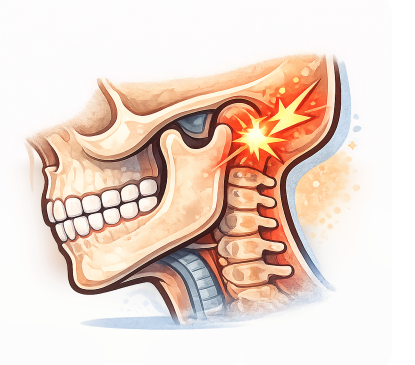
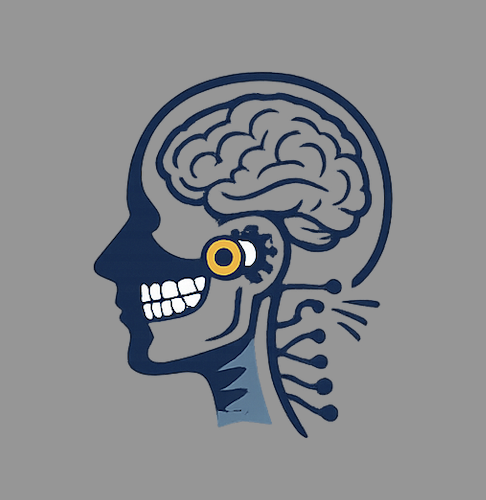
But what if one of the biggest stress-processing organs in your body is actually your jaw?
Sounds odd, doesn’t it?
Yet when we start exploring the relationship between chronic pain, emotional processing, inflammation, and the nervous system, the jaw begins to emerge as something far more important than simply a tool for chewing your lunch.
It may be one of the body’s favourite places to hide unresolved stress.
And your brain is paying attention.
Your Amygdala: The Eye of Sauron Living Inside Your Head
If you’ve ever watched The Lord of the Rings, you’ll remember the Eye of Sauron.
Always watching.
Always scanning.
Always looking for danger.
Your amygdala behaves in much the same way.
Located deep within the brain, the amygdala forms part of the limbic system—the emotional processing centre of the nervous system. Its primary job is survival.
It constantly asks questions such as:
“Am I safe?”
“Is there danger?”
“Should I prepare for a threat?”
The problem is that the amygdala isn’t particularly good at distinguishing between a charging tiger and an angry email from your boss.
To the nervous system, both can trigger a stress response.
When activated repeatedly, the amygdala can become highly sensitive, increasing vigilance, muscle tension, emotional reactivity, and pain perception.
Researchers now recognise that chronic pain isn’t simply a tissue problem.
It’s also a nervous system problem.
The longer pain persists, the more the brain learns to expect danger.
And when the brain expects danger, it amplifies sensitivity.
Sometimes dramatically.
Pain Is Not Just About Damage
One of the most important discoveries in modern pain science is that pain does not always reflect tissue damage.
Pain is a protective output from the brain.
Think of it as the body’s alarm system.
Sometimes the alarm goes off because there’s a genuine threat.
Other times it’s because someone burnt the toast.
The alarm may be loud.
But that doesn’t mean the house is on fire.
This helps explain why people can experience severe pain despite relatively normal scans.
It also explains why two people with similar injuries can experience vastly different levels of discomfort.
Pain is influenced by:
Previous experiences
Emotional stress
Anxiety
Sleep quality
Inflammation
Immune activity
Expectations
Social factors
Nervous system sensitivity
The body doesn’t separate these factors into neat little departments.
Everything talks to everything else.
Which brings us back to the jaw.
The Jaw: Your Psychological Emergency Exit
One of the most fascinating observations comes from Austrian Professor Rudolf Slavicek, one of the pioneers of interdisciplinary dentistry.
He proposed that the jaw serves functions far beyond chewing.
According to Slavicek:
“We use the masticatory organ as a kind of psychological emergency exit.”
That’s a pretty remarkable statement.
Think about what happens when you’re stressed.
You clench.
You grind.
You tighten your jaw.
You press your tongue against the roof of your mouth.
You develop headaches.
Your neck tightens.
Your shoulders creep toward your ears.
The jaw becomes part of the body’s stress-management strategy.
Not necessarily a good strategy.
But a common one.
The masticatory system doesn’t simply participate in eating.
It contributes to:
Breathing
Posture
Balance
Speech
Emotional regulation
Stress processing
In many people, the jaw becomes the place where emotional tension is physically stored.
The Jaw-Brain Connection Is Real
Interestingly, researchers have found that changing jaw position can influence activity in regions of the brain associated with emotional processing.
A fascinating fMRI study titled Influence of the TMJ Position on Limbic System Activation examined how different jaw positions affected brain activity.
The findings were remarkable.
When participants clenched their teeth, researchers observed increased activation within parts of the limbic system, including regions associated with emotional arousal and stress processing.
The study highlighted increased activity in areas linked to:
The amygdala
The anterior cingulate cortex (ACC)
Prefrontal cortical networks
These aren’t chewing centres.
These are emotional centres.
The same networks involved in:
Fear
Anxiety
Anticipation
Emotional regulation
Pain processing
In other words, the position and activity of your jaw may influence how your brain processes emotional information.
That’s a pretty big deal.
Why Chronic Pain Often Feels Emotional
Anyone who has lived with persistent pain already knows this.
Pain changes people.
Not because they’re weak.
Because pain changes the brain.
Chronic pain is associated with changes in:
Emotional regulation
Attention
Threat perception
Stress hormone production
Sleep quality
Immune function
Over time, the nervous system becomes more efficient at producing pain.
Not because it wants to hurt you.
Because it believes it’s protecting you.
The challenge becomes teaching the nervous system that the threat has reduced.
This process is sometimes referred to as neuroplasticity.
The brain learns.
And fortunately, it can also unlearn.
Inflammation: The Missing Piece
Another important factor often overlooked is inflammation.
We traditionally think of inflammation as swelling after an injury.
But inflammation can also be systemic.
Low-grade inflammation is now linked with:
Depression
Anxiety
Chronic fatigue
Autoimmune disease
Chronic pelvic pain
Fibromyalgia
Persistent musculoskeletal pain
Research on chronic pelvic pain, for example, increasingly demonstrates links between immune dysfunction, systemic inflammation, autoimmune mechanisms, and sensitisation of the nervous system.
When inflammation rises, the nervous system becomes more sensitive.
Pain thresholds decrease.
Recovery slows.
Stress resilience drops.
The body becomes stuck in protection mode.
It’s difficult to feel safe when your immune system thinks there’s a fire somewhere.
Why Breathing Matters More Than Most People Think
If the jaw influences stress and the brain influences pain, then breathing sits right in the middle of the conversation.
Breathing directly affects:
The autonomic nervous system
Heart rate variability
Emotional regulation
Muscle tension
Pain sensitivity
People under chronic stress often breathe:
Faster
Higher into the chest
Through the mouth
With increased neck and jaw tension
This creates a feedback loop.
Stress tightens the jaw.
Jaw tension alters breathing.
Poor breathing increases nervous system arousal.
Increased arousal increases pain sensitivity.
And around we go.
Reorganising Your Amygdala
The good news?
The nervous system remains adaptable throughout life.
Research increasingly supports interventions that help calm the threat-detection systems of the brain.
These include:
Mindfulness training
Movement therapy
Graded exposure to activity
Breathwork
Sleep optimisation
Cognitive approaches
Physical activity
Social connection
The goal isn’t to suppress the amygdala.
You still need your internal Eye of Sauron.
You just don’t want it treating every minor inconvenience like an invasion of Middle-earth.
What This Means Clinically
When someone presents with:
Jaw pain
Headaches
Neck tension
Chronic pain
Persistent fatigue
Pelvic pain
Bruxism (teeth grinding)
Stress-related symptoms
The question isn’t simply:
“What’s wrong with the tissue?”
The better question may be:
“What is the nervous system trying to protect?”
Because pain rarely exists in isolation.
The jaw, brain, immune system, breathing mechanics, posture, emotions, and movement patterns are all part of the same conversation.
The body operates as one integrated system.
Not a collection of disconnected parts.
And sometimes the key to reducing pain isn’t found where the pain is.
It’s found in understanding why the alarm system remains switched on.
If you’ve been chasing pain from one body part to another without lasting success, it may be worth widening the lens.
Your jaw isn’t just for chewing.
Your brain isn’t just for thinking.
Your immune system isn’t just for fighting infection.
And pain isn’t always a sign that something is damaged.
Sometimes pain is a message from a nervous system that’s working overtime to keep you safe.
The challenge is helping it realise the danger has passed.
And occasionally, that journey starts with something as simple as becoming aware of your jaw.
Go on.
Check it now.
There’s a reasonable chance you’re clenching.
Again.
References
Apkarian, A.V., Hashmi, J.A. & Baliki, M.N., 2011. Pain and the brain: specificity and plasticity of the brain in clinical chronic pain. Pain, 152(3), pp.S49-S64.
Bushnell, M.C., Čeko, M. & Low, L.A., 2013. Cognitive and emotional control of pain and its disruption in chronic pain. Nature Reviews Neuroscience, 14(7), pp.502-511.
LeDoux, J., 2000. Emotion circuits in the brain. Annual Review of Neuroscience, 23, pp.155-184.
Loggia, M.L. et al., 2015. Evidence for brain glial activation in chronic pain patients. Brain, 138(3), pp.604-615.
Mavrommatis, M.A. et al., 2017. Influence of the TMJ position on limbic system activation: an fMRI study. Journal of Oral Rehabilitation, 44(11), pp.878-887.
Slavicek, R., 2008. The Masticatory Organ: Functions and Dysfunctions. Vienna: Gamma Dental.
Tracey, I. & Mantyh, P.W., 2007. The cerebral signature for pain perception and its modulation. Neuron, 55(3), pp.377-391.
Zondervan, K.T. et al., 2020. Endometriosis and chronic pelvic pain: pathophysiology and therapeutic implications. The Lancet, 397(10276), pp.839-852.
Wiech, K., 2016. Deconstructing the sensation of pain: the influence of cognitive processes on pain perception. Science, 354(6312), pp.584-587.
Unlearning Anxiety. Reorganising Your Amygdala. Available at: https://www.unlearninganxiety.com/amygdala