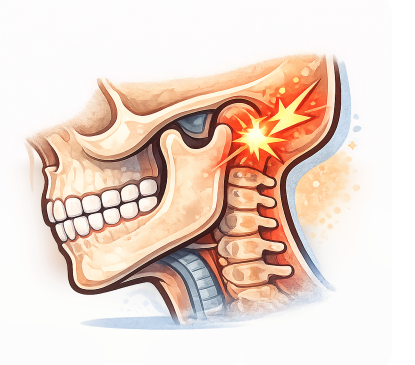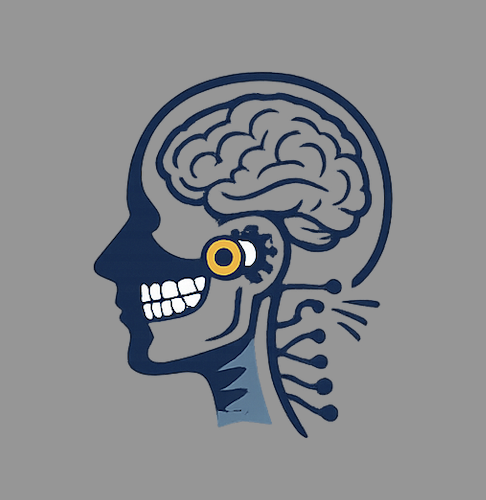
Most conversations about TMJ disorders start and end with the jaw.
The bite is wrong.
The disc is displaced.
The teeth don’t meet properly.
The jaw clicks.
Case closed.
Or is it?
Over the past two decades, researchers have increasingly questioned whether temporomandibular disorders (TMD) are simply mechanical problems involving the jaw joint and teeth. Emerging evidence suggests that many chronic TMJ symptoms may involve dysregulation of the autonomic nervous system, altered pain processing within the brain, disturbed sleep, chronic stress and neuro-inflammatory pathways rather than purely local joint pathology (Monaco et al., 2012; Yin et al., 2020).
In other words, the jaw may not be the primary problem.
It may be the messenger.
Is TMJ a Nervous System Disorder?
One of the most interesting studies investigating this question came from Monaco and colleagues (2012), who examined autonomic nervous system function in patients with temporomandibular disorders using pupillometry.
Pupillometry measures how the pupil responds to changes in light and autonomic nervous system activity. The researchers found significant differences between people with TMD and healthy controls, suggesting altered autonomic regulation in those suffering from chronic jaw pain.
This is important because the autonomic nervous system regulates:
Muscle tone
Pain sensitivity
Heart rate
Blood pressure
Sleep physiology
Inflammatory responses
Stress adaptation
If this system becomes dysregulated, symptoms can appear almost anywhere.
Including the jaw.
Monaco and colleagues proposed that TMD may involve dysfunction of the autonomic nervous system itself rather than being purely a local musculoskeletal problem.
That is a very different way of thinking about jaw pain.
The Jaw and the Emotional Brain
For decades the jaw was viewed largely as a mechanical structure.
However, neuroimaging studies suggest something much more interesting may be occurring.
An MRI study investigating jaw position and brain activity found that changes in temporomandibular joint position influenced activation within several limbic structures, including the amygdala and anterior cingulate cortex (Otsuka et al., 2011).
These are not chewing centres.
These are emotional processing centres.
The amygdala plays a major role in:
Fear
Threat detection
Emotional arousal
Stress responses
The anterior cingulate cortex is heavily involved in:
Pain perception
Anticipation
Anxiety
Emotional regulation
The researchers observed increased activation within these regions when participants altered jaw position and performed clenching tasks.
The implication is fascinating.
The jaw appears capable of influencing areas of the brain responsible for processing emotions and pain.
Or perhaps equally important:
The emotional brain may influence the jaw.
Chronic Jaw Pain Changes the Brain
The relationship doesn’t stop there.
A systematic review by Yin and colleagues (2020) examined structural and functional MRI studies involving people with temporomandibular disorders.
The review found consistent alterations in brain regions associated with:
Pain modulation
Motor control
Emotional regulation
Attention
Sensory processing
The authors concluded that chronic TMD is associated with widespread changes throughout the central nervous system.
This is remarkably similar to what researchers observe in other persistent pain conditions such as fibromyalgia, chronic low back pain and migraine.
In simple terms:
The longer pain persists, the more the nervous system learns the pain experience.
This process is known as central sensitisation.
The nervous system becomes increasingly efficient at producing pain—even when tissue damage may be minimal.
The Trigeminal Nerve and the Sympathetic Nervous System
One of the most fascinating areas of current research involves the interaction between the trigeminal nerve and the sympathetic nervous system.
The trigeminal nerve provides sensation to much of the face and jaw.
Research demonstrates that sympathetic nervous system activation can directly influence trigeminal pain pathways through neurotransmitters and inflammatory signalling molecules including:
Calcitonin Gene-Related Peptide (CGRP)
Substance P
Neurotrophins
Cytokines
Norepinephrine
Monaco et al. (2015) demonstrated that these pathways may contribute to increased sensitivity of pain receptors and immune cells surrounding trigeminal structures.
This may help explain why stress frequently worsens:
Jaw pain
Headaches
Facial pain
Teeth grinding
Neck tension
The nervous system is not merely responding to pain.
It may be actively amplifying it.
Stress, Anxiety and Depression: The Missing Link?
One of the most consistent findings in TMD research is the strong relationship between psychosocial stress and symptom severity.
Multiple studies have found associations between temporomandibular disorders and:
Anxiety
Depression
Emotional distress
Chronic stress
Poor coping capacity
A recent review by Lin et al. (2024) found that psychosocial factors significantly influence both the development and persistence of TMD symptoms.
Importantly, this does not mean the pain is psychological.
Far from it.
The pain is real.
What it means is that the nervous system, immune system and emotional centres of the brain are deeply interconnected.
The jaw simply happens to be one of the places where this interaction becomes visible.
Sleep: The Forgotten Treatment
Perhaps the biggest elephant in the room is sleep.
Poor sleep alters:
Pain thresholds
Autonomic regulation
Cortisol production
Inflammatory markers
Emotional resilience
Muscle responsiveness
Many patients with TMJ disorders report:
Bruxism
Sleep disturbances
Frequent waking
Non-restorative sleep
Fatigue
This creates a vicious cycle:
Poor sleep → Increased sympathetic activation → Increased muscle tension → Increased jaw clenching → Increased pain → Worse sleep.
The jaw becomes trapped in a self-perpetuating loop.
When clinicians focus exclusively on occlusion and bite mechanics, this entire physiological picture can be missed.
What About the Neck?
The jaw and neck function as a single integrated system.
Research consistently demonstrates relationships between cervical dysfunction and TMD symptoms.
This makes anatomical sense.
The trigeminal system communicates with upper cervical structures through the trigeminocervical complex.
The upper cervical spine, jaw, airway, tongue and cranial nerves all share close neurological relationships.
This helps explain why many patients with chronic TMJ pain also experience:
Neck pain
Headaches
Dizziness
Postural dysfunction
Breathing issues
The jaw is rarely acting alone.
The emerging research paints a very different picture of TMJ disorders than the one many of us learned years ago.
Rather than viewing TMD solely as a mechanical problem of the jaw joint, it may be more useful to view it as a condition sitting at the intersection of:
Nervous system regulation
Emotional processing
Sleep quality
Cervical spine function
Breathing mechanics
Inflammatory signalling
Pain neuroscience
The jaw matters.
But so does the system controlling it.
Sometimes treating the jaw helps.
Sometimes improving sleep helps.
Sometimes addressing breathing, neck mobility, stress physiology or nervous system regulation creates the biggest change.
Because occasionally the jaw isn’t the problem.
It’s simply the loudest part of the conversation.
References
Monaco A, Cattaneo R, Mesin L, et al. Dysregulation of the autonomic nervous system in patients with temporomandibular disorder: A pupillometric study. PLoS One. 2012;7(9):e45424.
Monaco A, Cattaneo R, Mesin L, et al. Dysregulation of the descending pain system in temporomandibular disorders revealed by low-frequency sensory transcutaneous electrical nerve stimulation. PLoS One. 2015;10(4):e0120647.
Otsuka T, Fukuda M, Ueda M, et al. Influence of the TMJ position on limbic system activation: An fMRI study.
Yin Y, He S, Xu J, et al. Structural and functional MRI studies in temporomandibular disorders: A systematic review. NeuroImage Clinical. 2020;28:102426.
Lin J, et al. Associations between temporomandibular disorders and psychosocial factors. International Journal of Oral and Maxillofacial Surgery. 2024.
Abbass MMS, et al. The temporomandibular joint and the human body. Dentistry Journal. 2024;12(11):357.