Most people think cavities are all about sugar.
Eat too many lollies, forget to floss, and your dentist gets a new boat.
But what if one of the biggest influences on your dental health isn’t what’s going into your mouth… it’s how you’re breathing through it?
It sounds strange, yet growing evidence suggests that nasal breathing plays a major role in oral health, facial development, sinus growth, saliva production, and even cavity risk.
And the effects start surprisingly early in life.

Mouth Breathing, Nasal Breathing and Cavities: Is Your Nose Secretly Protecting Your Teeth?
Your Face Doesn’t Just Grow. It Responds to Function.
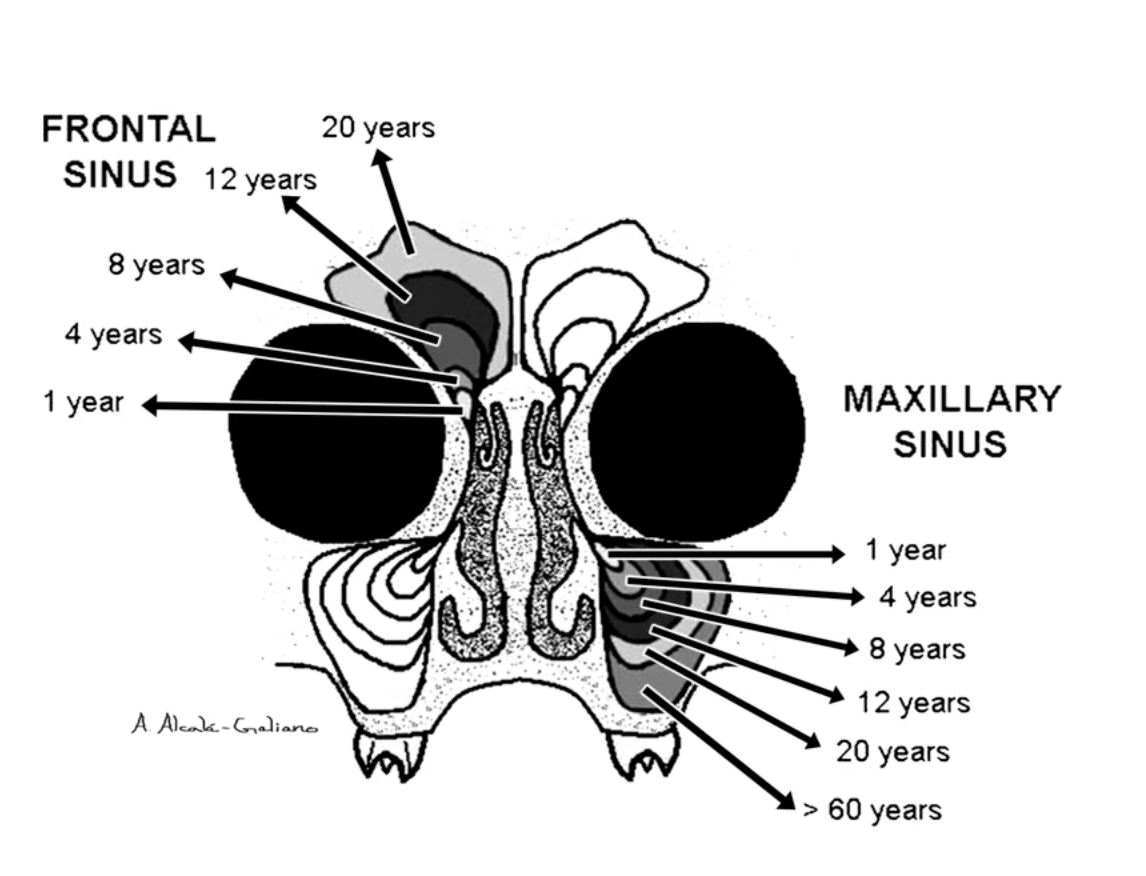
Take a look at the image above.
The frontal and maxillary sinuses are tiny at birth and continue developing throughout childhood and adolescence. The frontal sinuses don’t reach adult size until around 20 years of age, while the maxillary sinuses continue expanding through puberty and beyond.
This isn’t simply a passive process where the skull follows a genetic blueprint.
Modern research suggests facial growth is strongly influenced by function:
How we breathe
How we chew
Tongue posture
Swallowing patterns
Airway development
Head and neck posture
In other words, the face develops partly in response to how it is used.
Think of it like a tree growing around the wind.
The environment matters.
Why the Nose Matters
Your nose is far more than a decorative attachment for holding sunglasses.
It performs several critical jobs:
Air Filtration
Tiny hairs and mucus trap particles, allergens, bacteria and pollutants before they reach the lungs.
Your mouth, on the other hand, is basically the express lane.
No security check. No baggage screening. Just straight through.
Humidification
The nose warms and moistens incoming air.
This helps protect the airways and improves gas exchange within the lungs.
Nitric Oxide Production
The nasal passages produce nitric oxide (NO), a signalling molecule with important physiological effects.
Nitric oxide helps:
Dilate blood vessels
Improve oxygen delivery
Support immune function
Reduce bacterial growth
Improve ventilation-perfusion matching in the lungs
When you breathe through your mouth, you largely bypass this natural system.
Mouth Breathing Changes More Than Your Airway
Chronic mouth breathing has been associated with:
Altered facial growth
Narrow upper jaws
Dental crowding
Higher palates
Forward head posture
Increased risk of sleep-disordered breathing
Children who predominantly breathe through their mouths often develop a different craniofacial pattern compared to children who breathe through their noses.
Researchers sometimes refer to this as the “long face syndrome” pattern.
The tongue normally rests against the roof of the mouth, helping support maxillary development.
When breathing shifts to the mouth, the tongue often drops lower in the oral cavity.
The result?
The upper jaw may not receive the same developmental stimulus, potentially contributing to narrower dental arches and crowded teeth.
What Does This Have To Do With Cavities?
Quite a lot, actually.
The link is saliva.
Saliva: The Unsung Hero of Dental Health
Saliva is one of the body’s most underrated superpowers.
It:
Neutralises acids
Buffers pH changes
Washes away food particles
Delivers minerals for tooth remineralisation
Contains antimicrobial proteins
Protects enamel
Every time you eat carbohydrates, bacteria produce acids that temporarily lower the pH around your teeth.
If saliva is functioning well, it helps restore balance.
Think of saliva as the clean-up crew arriving after a rowdy house party.
Without it, things get messy quickly.
Mouth Breathing Dries Everything Out
Chronic mouth breathing increases evaporation from oral tissues.
This often leads to:
Dry mouth (xerostomia)
Reduced salivary protection
Higher bacterial counts
More acidic oral environments
Multiple studies have found that mouth-breathing children tend to have:
More plaque accumulation
Higher rates of gingivitis
Increased cavity risk
Greater enamel demineralisation
When saliva decreases, cavity-causing bacteria get a significant advantage.
It’s like removing the goalkeeper and wondering why more goals are being scored.
Sleep Might Be The Missing Piece
Many people breathe through their noses during the day and their mouths at night.
This is where things become interesting.
Sleep-related mouth breathing may result from:
Nasal congestion
Allergies
Enlarged adenoids
Deviated septum
Sleep-disordered breathing
Poor tongue posture
During sleep, reduced saliva production is already normal.
Add mouth breathing into the mix and you create the perfect environment for:
Dry mouth
Increased bacterial growth
Morning bad breath
Higher cavity risk
Many dentists now routinely ask about snoring, sleep quality and mouth breathing because the relationship is becoming increasingly difficult to ignore.
Can Nasal Breathing Reduce Cavities?
Potentially, yes.
But let’s avoid oversimplifying things.
Nasal breathing is not a magical cavity cure.
You still need:
Good oral hygiene
Appropriate fluoride exposure
A nutrient-rich diet
Sensible sugar intake
Regular dental care
However, improving nasal breathing may help support the natural protective mechanisms that already exist within the mouth.
In simple terms:
Better nasal breathing → healthier saliva function → improved oral environment → potentially lower cavity risk.
Why This Matters For The Whole Body
One of the most fascinating aspects of breathing is that it connects systems we often treat as separate.
The nose influences:
Sleep quality
Facial development
Airway health
Nervous system regulation
Oxygen delivery
Dental health
The mouth, teeth, tongue, jaw, neck and airway are not isolated structures.
They’re part of the same interconnected system.
This is why clinicians working in dentistry, airway health, sleep medicine, movement therapy and craniofacial development are increasingly having the same conversation.
Breathing matters.
A lot.
Cavities aren’t simply a “brush better” problem.
They are influenced by an entire ecosystem that includes saliva, airway health, sleep quality, tongue posture and breathing habits.
The growing body of research suggests that nasal breathing may play an important role in maintaining oral health by supporting saliva production, reducing oral dryness and helping normal facial development.
So if you wake up every morning with a dry mouth, bad breath, or a constant need for water beside the bed, it might be worth asking a bigger question:
Is the problem really your teeth… or is your nose trying to tell you something?
References
Abreu RR, Rocha RL, Lamounier JA, Guerra ÂF. Mouth breathing in children: impact on dentofacial development. Brazilian Journal of Otorhinolaryngology. 2008;74(5):698-702.
Feștilă D, Mesaros AS, Nemes A, et al. Oral Breathing Effects on Malocclusions and Mandibular Positioning in Children and Adolescents: A Systematic Review. Children. 2025;12(1):72.
Jefferson Y. Mouth breathing: adverse effects on facial growth, health, academics, and behavior. General Dentistry. 2010;58(1):18-25.
Lin L, Zhao Y, Hu K, Zhang P. The impact of mouth breathing on dentofacial development: A concise review. Frontiers in Public Health. 2022;10:929165.
Moss ML. The functional matrix hypothesis revisited. 1. The role of mechanotransduction. American Journal of Orthodontics and Dentofacial Orthopedics. 1997;112(1):8-11.
Pacheco MC, Casagrande CF, Teixeira LP, Finck NS, Araújo MT. Guidelines proposal for clinical recognition of mouth breathing children. Dental Press Journal of Orthodontics. 2015;20(4):39-44.
de la Garza A, et al. Pediatric Facial Fractures and Potential Long-Term Growth Disturbances. Radiographics. 2008;28(7):2031-2046.
Zhao Z, Zheng L, Huang X, Li C, Liu J, Hu Y. Effects of mouth breathing on facial skeletal development in children: A systematic review and meta-analysis. Laryngoscope. 2021;131(5):E1708-E1716.